Asphalt Shingle vs Metal Roofing Costs and Lead Opportunities
Asphalt shingle vs metal roofing costs and lead opportunities explained, from installed pricing to close rates. Call 5106637016 to get started.

By Julia Ellis
The choice between asphalt shingles and metal roofing shapes more than a homeowner's curb appeal. It determines project budgets, resale value, and the volume of qualified leads flowing to contractors who know how to position each option. Roofers who understand the real cost gap between these two materials, and who can translate that gap into a clear sales conversation, close more jobs and waste fewer hours chasing price shoppers. This breakdown covers installed costs, lifespan math, insurance and resale angles, and the lead generation opportunities hiding inside both categories.
Installed Cost Reality: Asphalt Shingle vs Metal Roofing
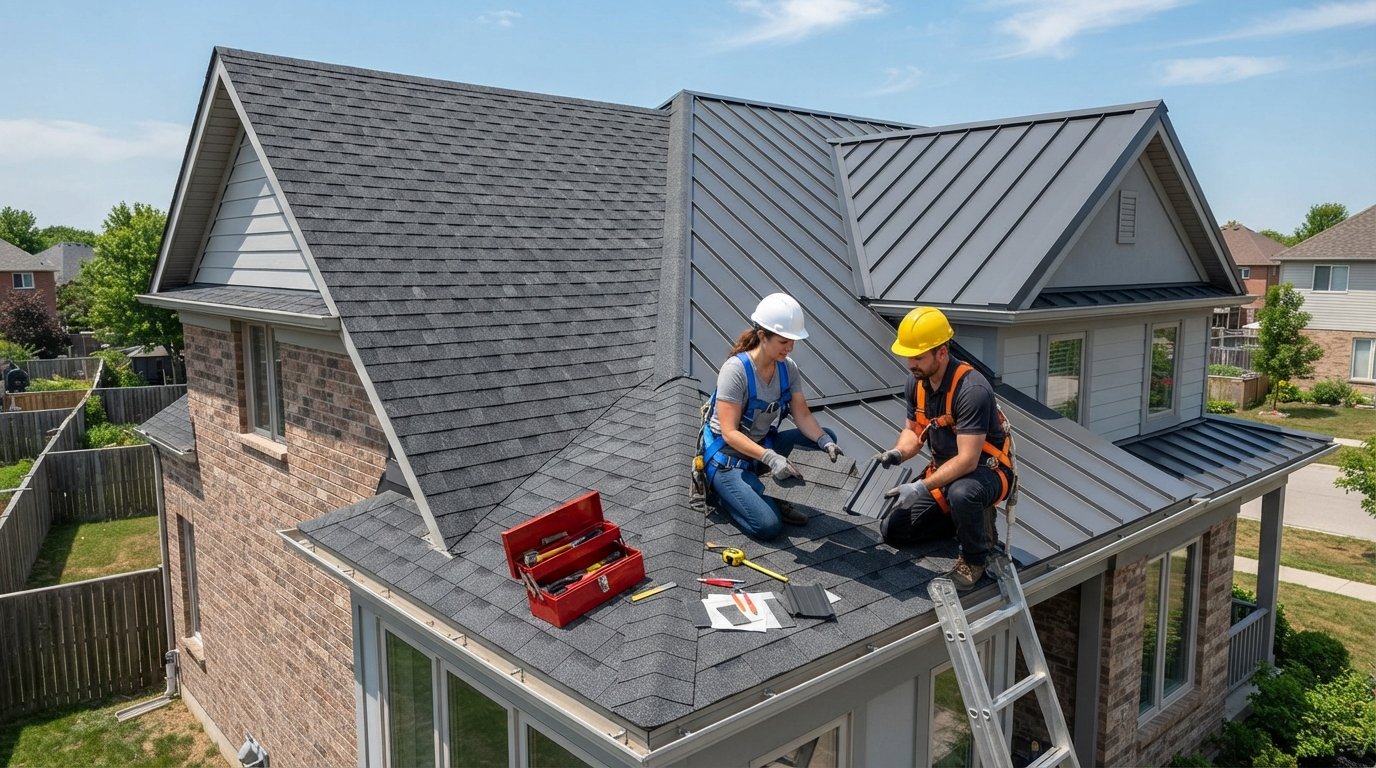
National averages put asphalt shingle installation between $5,500 and $12,000 for a typical 1,700 to 2,100 square foot roof, which works out to roughly $3.50 to $5.50 per square foot installed. Metal roofing runs $8,000 to $25,000 or more for the same footprint, translating to $7.00 to $14.00 per square foot depending on whether the homeowner chooses exposed-fastener panels, standing seam, or stone-coated steel. Those ranges assume a straightforward tear-off, standard pitch, and no structural repairs.
The gap widens fast when complexity enters the picture. A steep pitch, multiple dormers, skylights, or a second layer of existing shingles can push asphalt toward the top of its range and metal well past $30,000. Homeowners often anchor on the asphalt number first because it is familiar, then experience sticker shock when a metal quote arrives. Contractors who present both options with transparent line items, material, labor, disposal, underlayment, flashing, and permits, build trust faster and reduce the back-and-forth that kills margins.
It helps to frame the comparison as a monthly ownership cost rather than a single invoice. A $9,000 asphalt roof replaced every 18 to 20 years costs roughly $450 to $500 per year across its life. A $20,000 metal roof lasting 50 years costs about $400 per year, and that math does not include the energy savings or insurance discounts metal often delivers. When contractors lead with lifetime cost instead of sticker price, the perceived gap shrinks and premium jobs become easier to sell.
Lifespan, Maintenance, and Long-Term Value
Architectural asphalt shingles typically last 18 to 25 years in moderate climates and closer to 12 to 15 years in hail-prone or high-UV regions. Three-tab shingles, still common on budget jobs, often fail in 10 to 15 years. Metal roofing, by contrast, carries a 40 to 70 year lifespan depending on coating and gauge, with standing seam aluminum or steel frequently outlasting the home itself. That difference changes how homeowners think about the project: asphalt is a recurring expense, while metal is closer to a permanent upgrade.
Maintenance profiles diverge just as sharply. Asphalt requires periodic granule loss inspection, occasional patching, and full replacement within two decades. Metal needs almost nothing beyond checking fasteners on exposed-panel systems and rinsing debris from valleys. Homeowners who plan to stay in the house for 20 or more years, or who are tired of repeat roof bills, are strong metal candidates. Homeowners planning to sell within five to seven years usually recover more of their investment with architectural asphalt, which looks familiar to buyers and appraisers.
Resale value is where the two materials play differently in different markets. Asphalt offers a reliable cost recouped at resale, often in the 60 to 70 percent range for mid-range homes. Metal can push higher in rural, coastal, or wildfire-prone areas where durability and fire resistance command a premium. Contractors who track local sale data and HOA rules can position the right material for each neighborhood instead of pitching the same roof to every lead.
Insurance, Energy, and Financing Angles That Close Deals
Insurance carriers increasingly reward metal roofing with premium discounts, sometimes 10 to 30 percent, because metal resists hail, wind, and fire better than asphalt. In states like Florida, Texas, and Colorado, where hail claims drive premium increases, that discount can offset a meaningful share of the upfront cost over a decade. Asphalt still qualifies for standard coverage, but homeowners replacing a roof after a claim often face higher deductibles or actual cash value policies that make them open to upgrading.
Energy performance adds another lever. Metal roofs with reflective coatings or cool-roof pigments can cut cooling costs by 10 to 25 percent in hot climates, while asphalt shingles absorb heat and radiate it into the attic. In northern markets, the benefit is smaller but still real when paired with proper ventilation and insulation. Contractors who bring an attic temperature reading or a utility bill comparison to the sales appointment turn a price objection into a payback conversation.
Financing bridges the remaining gap. Homeowners who cannot write a $20,000 check often can handle a $250 to $350 monthly payment, especially when that payment replaces a utility bill increase or an insurance surcharge. Offering a financing option at the point of sale, whether through a lender or a home equity product, keeps the project moving. For contractors watching cash flow, partnering with a service that connects lenders to homeowners, such as MortgageLeads, can add a referral stream without adding staff.
Where the Lead Opportunities Live for Roofing Contractors
Every asphalt versus metal decision starts with a homeowner who is actively researching, comparing quotes, or reacting to storm damage. That research window is short, often two to four weeks, and the contractor who responds first usually wins the job. This is where a pre-qualified roofing lead outperforms a cold list. The homeowner has already answered questions about roof type, age, material preference, and timeline, which lets the contractor skip the discovery phase and go straight to the estimate.
Lead platforms such as finding quality remodeling leads for roofing projects make this process systematic. Instead of buying a generic list and dialing through wrong numbers, contractors purchase leads filtered by category, location, and project intent. Roofing leads are among the highest-value categories on these exchanges because the average ticket is large and the urgency is real. Exclusive roofing leads often price around $45, while shared roofing leads run closer to $15, and the right choice depends on the contractor's close rate and capacity.
The asphalt versus metal split creates two distinct lead profiles. Asphalt leads tend to be price-sensitive, faster to close, and more likely to come from insurance claims or budget replacements. Metal leads skew toward longer sales cycles, higher budgets, and homeowners planning to stay in the home. Contractors who build separate follow-up sequences for each profile convert more of both. A metal lead that gets the same one-call treatment as an asphalt lead will often go cold, while an asphalt lead buried in a long education sequence will buy from a competitor.
Seasonality matters too. Storm season floods the market with asphalt replacement demand, while spring and summer bring metal upgrade inquiries from homeowners planning additions or energy retrofits. Contractors who keep lead volume steady across both seasons smooth out revenue and keep crews busy. Tracking which lead source produces which material preference, and which closes at the best margin, turns lead buying from a guessing game into a measurable channel.
Building a Cost and Lead Strategy That Works
The most profitable roofing contractors treat material choice and lead generation as one system, not two separate decisions. They know their cost per lead, their close rate by material type, and their average ticket for asphalt versus metal. With those three numbers, they can decide how much to pay for an exclusive metal lead versus a shared asphalt lead and still hit margin targets.
A practical framework looks like this: track every lead by source, material interest, and outcome for at least one quarter, then calculate cost per acquired job for each combination. Contractors who do this usually find that exclusive leads close at two to three times the rate of shared leads, which often justifies the higher price. They also find that metal leads, while fewer, produce larger tickets and better referral rates, making them worth a longer nurture sequence.
Response speed remains the single biggest lever. Homeowners contacting multiple contractors typically hire the first one who responds with a professional, specific follow-up. Automated text and email acknowledgments within five minutes, followed by a phone call within an hour, dramatically improve conversion. Pairing that speed with a clear asphalt-versus-metal presentation, complete with lifetime cost math and financing options, gives the contractor an advantage that price alone cannot erase.
Finally, contractors should not ignore the referral loop. A homeowner who chooses metal often becomes a vocal advocate in neighborhoods where metal is still rare. A homeowner who chooses asphalt on a tight timeline becomes a repeat customer in 15 to 20 years. Both outcomes start with a well-qualified lead, a fast response, and a sales process that respects the homeowner's budget while showing the full picture. Roofers who master that combination will find that the asphalt shingle versus metal roofing debate is not a problem to solve, but a pipeline to build.