
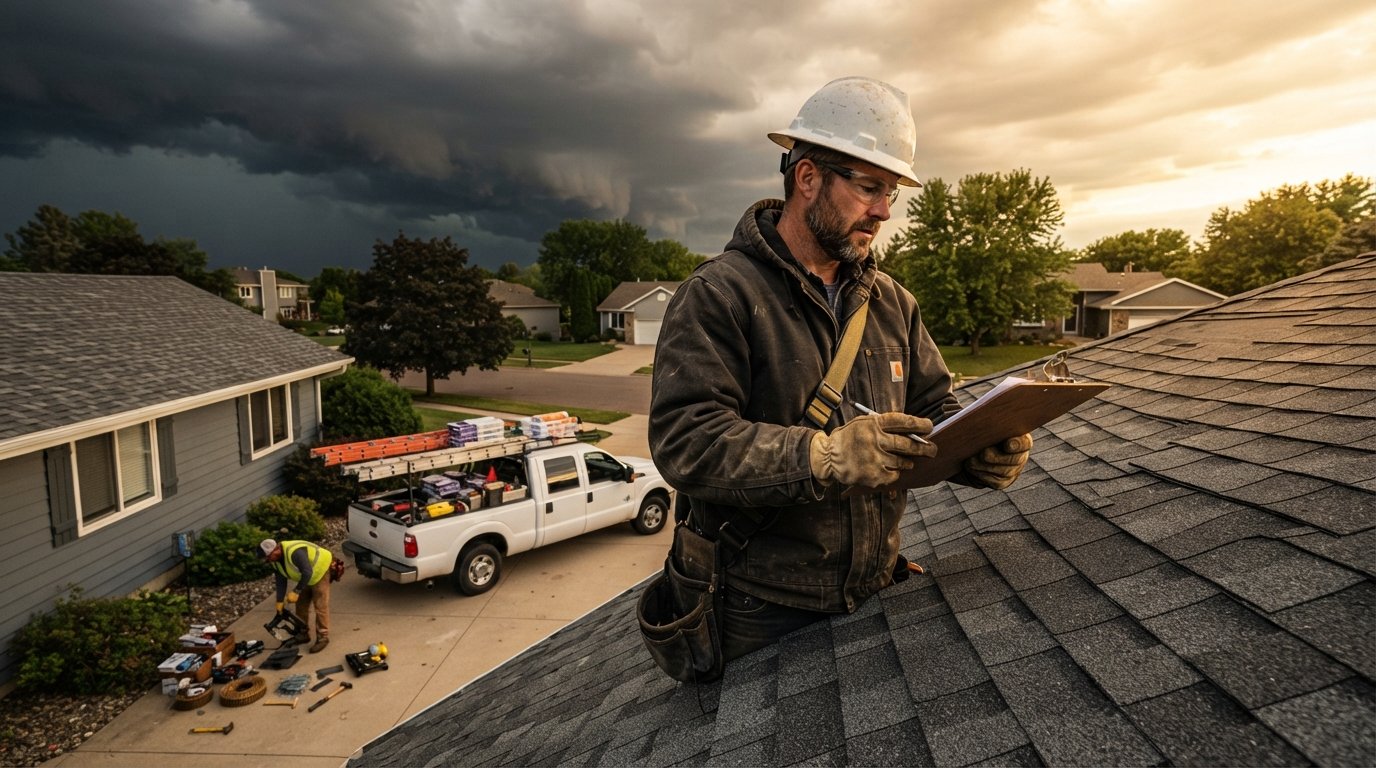
Storm Season Prep Checklist for Roofing Contractors
Get your crew storm-ready with this practical storm season prep checklist for roofing contractors. Call (510)-663-7016 for lead support and scheduling help.

By Julia Ellis
Storm season does not announce itself with a formal invitation. It arrives as a line of dark clouds on a Tuesday afternoon, and by Wednesday morning your phone is ringing nonstop with homeowners who have missing shingles, dented gutters, and water stains spreading across their ceilings. The contractors who thrive during these weeks are not the ones who react fastest in the moment. They are the ones who spent the weeks and months beforehand building a system that can absorb a sudden surge of demand without breaking under the pressure.
This storm season prep checklist for roofing contractors is designed to help you do exactly that. Whether you are a solo operator or running multiple crews, the goal is the same: position your business to capture storm-driven revenue, protect your margins, and keep your team sane while everyone else is scrambling. The checklist covers staffing, scheduling, lead response, documentation, and the delicate art of keeping your regular replacement pipeline alive when storm work threatens to consume every available hour.
Start With a Staffing and Scheduling Audit Before the First Storm
The single biggest failure point during storm season is labor. Storm damage does not arrive in a predictable trickle. It arrives as a flood, and if you do not have a plan for scaling your crew capacity, you will spend the entire season turning down work or burning out the people you have. A staffing audit is the first item on any serious storm season prep checklist for roofing contractors because everything else depends on having enough hands to execute.
Begin by mapping your current crew against a realistic storm scenario. If a moderate hail event hits your service area, how many additional inspections could your team handle in a week? How many full replacements could you realistically install? Identify the gap between your current capacity and your storm-season capacity, then decide how you will close it. Some contractors bring on temporary labor, some cross-train office staff to handle scheduling and customer communication, and some build relationships with subcontractor crews they can call when volume spikes.
Here is a practical framework for the staffing audit:
- List every role in your operation, from lead intake to final inspection, and identify which roles become bottlenecks during a surge.
- Estimate your maximum weekly inspection and installation capacity with current staff, then compare it to a realistic storm scenario.
- Decide which gaps you will fill with overtime, temporary hires, subcontractors, or by prioritizing higher-margin jobs.
- Document your plan in writing so that everyone knows what happens when the phone starts ringing.
Once you understand your capacity, build a scheduling system that can flex. That might mean reserving certain days for storm inspections and others for scheduled replacements, or it might mean creating a triage system where your most experienced estimator handles the highest-value storm leads first. The key is to have the system in place before the storm, not to invent it while you are standing on a roof with hail still falling.
Build a Lead Response Protocol That Protects Your Crews
Storm damage leads are time-sensitive. Homeowners who call you on day one are often the same homeowners calling three other contractors, and the first company to show up with a professional inspection and a clear explanation of next steps usually wins the job. But responding fast does not mean responding chaotically. Without a protocol, your crews will end up driving across three counties chasing leads that were never qualified, and your close rate will suffer.
The solution is a lead response protocol that combines speed with qualification. When a storm lead comes in, your first contact should happen within minutes, not hours. That initial contact can be a phone call, a text message, or an automated response that confirms receipt and sets expectations. The goal is to acknowledge the homeowner, gather basic information about the damage, and schedule an inspection before your competitors even return the call.
However, not every storm lead deserves the same level of attention. Some homeowners have minor cosmetic damage that may not even meet their insurance deductible. Others have active leaks that require emergency tarping and immediate attention. A tiered response system helps you allocate your crews efficiently. You might use a simple three-tier model:
- Emergency leads: Active leaks, structural concerns, or safety hazards. These get same-day response and immediate tarping or temporary repairs.
- High-value leads: Significant damage that clearly exceeds deductibles and is likely to result in a full replacement. These get priority scheduling within 24 to 48 hours.
- Standard leads: Minor damage or homeowners still deciding whether to file a claim. These can be scheduled within a few days or handled through a follow-up sequence.
This tiered approach does two things. It ensures that the most urgent and most valuable leads get fast attention, and it prevents your crews from burning out on low-probability inspections. It also gives you a way to communicate with homeowners about when they can expect to hear from you, which reduces frustration and builds trust.
If you are looking to supplement your storm-season pipeline with additional qualified leads, it helps to understand how specialized lead sources work. Our guide on gutter installation leads for roofing contractors explains how to evaluate and integrate lead sources that align with your storm-season capacity, so you are not paying for leads you cannot service.
Document Damage Thoroughly for Insurance and Homeowner Confidence
Storm damage documentation is where many roofing contractors leave money on the table. Homeowners who file insurance claims need clear, organized evidence of the damage, and adjusters respond better to contractors who present a professional, complete package. If your documentation is sloppy, the claim can be delayed, reduced, or denied, and the homeowner may blame you for the outcome.
Build a documentation standard that every crew member follows on every storm inspection. At a minimum, that standard should include wide-angle photos of each roof elevation, close-up photos of specific damage (hail hits, wind-lifted shingles, granule loss), photos of collateral damage (gutters, vents, siding, skylights), and a written summary that describes the damage in plain language. Date-stamp everything and organize it by address and claim number.
Beyond photos, consider using a simple digital checklist that your inspectors complete on a tablet or phone. This ensures consistency across your team and gives you a searchable record if questions arise later. It also makes it easy to share documentation with homeowners and adjusters in a format that looks professional and organized. Homeowners who see that you take documentation seriously are more likely to trust you with the repair, and adjusters who receive a complete package are more likely to approve the claim without unnecessary back-and-forth.
Documentation also protects you. If a homeowner later claims that damage was caused by your crew rather than the storm, your pre-inspection photos and notes provide a clear record of the roof's condition before you touched it. This is especially important in storm season when emotions run high and disputes are more common.
Balance Storm Work With Your Replacement Pipeline
One of the hidden risks of storm season is that it can cannibalize your regular business. When storm work is abundant, it is tempting to pour every resource into storm inspections and installations. But storm seasons end, and when they do, contractors who neglected their replacement pipeline find themselves with empty schedules and no leads in the funnel.
The solution is to set clear boundaries around how much of your capacity you will dedicate to storm work versus your ongoing replacement pipeline. For example, you might decide that storm work can consume up to 70 percent of your installation capacity during peak weeks, but the remaining 30 percent stays reserved for scheduled replacements and maintenance customers. You might also decide that certain crew members or estimators remain dedicated to non-storm work so that your regular customers do not feel abandoned.
Communication is key here. If a regular customer's replacement has to be delayed because of storm demand, call them personally, explain the situation, and give them a new date. Most homeowners understand that storms create emergencies, but they remember how you handled the delay. A proactive call is far better than a silent rescheduling.
It also helps to keep your marketing and lead generation running through storm season, even if you are busy. If you turn off your lead sources entirely, you will have a gap in your pipeline that takes weeks or months to refill. Instead, adjust your lead volume to match your available capacity, and keep your brand visible so that homeowners who are not filing storm claims still think of you when they need a replacement.
For contractors who want to build a more predictable pipeline that can withstand seasonal swings, performance-based lead generation platforms can be a useful complement to your own marketing. Services like PayPerCallMarketing connect contractors with homeowners who are actively seeking roofing services, and you pay only for qualified calls, which can help you manage cash flow during slower periods.
Prepare Your Equipment, Materials, and Supply Chain
Storm season puts enormous pressure on your supply chain. Shingles, underlayment, nails, and flashing that are normally available on short notice can become scarce when every contractor in the region is ordering at once. If you wait until the storm hits to stock up, you will be competing for materials with everyone else, and your installation schedule will slip.
Build a storm-season inventory plan that accounts for the materials you are most likely to need. That means common shingle colors and profiles, standard underlayment, and the fasteners and sealants that go with them. You do not need to hoard materials, but you should have enough on hand to handle a reasonable surge without waiting for a delivery. Talk to your suppliers about their storm-season availability and ask whether they offer priority fulfillment for regular customers.
Equipment matters too. Storm season is hard on trucks, ladders, and tools. Schedule maintenance before the season starts so that you are not dealing with a broken ladder or a failed compressor in the middle of a busy week. Make sure every crew has access to tarps, temporary repair materials, and safety equipment, and that everyone knows where to find them.
Train Your Team on Storm-Specific Communication
Storm damage conversations are different from regular replacement conversations. Homeowners are often stressed, confused about insurance, and vulnerable to unscrupulous contractors who show up after storms looking for quick profits. Your team needs to be able to explain the process clearly, set realistic expectations, and reassure homeowners that they are working with a legitimate professional.
Train your estimators and office staff on how to talk about insurance claims, deductibles, and the difference between temporary repairs and permanent replacements. Give them scripts or talking points so that everyone communicates the same message. Emphasize empathy: a homeowner with a leaking roof is not just a lead, they are someone whose home is damaged. The contractors who treat storm victims with respect and patience are the ones who earn referrals and repeat business long after the storm is forgotten.
Also train your team on how to identify and document potential insurance fraud or storm-chaser activity. If a homeowner has already been approached by a contractor who is pressuring them to sign a contract immediately or offering to waive their deductible, that is a red flag. Your team should know how to handle those situations professionally and ethically.
Review Your Insurance and Contracts Before the Season Starts
Storm season is not just about homeowner insurance claims. It is also about your own business insurance. Make sure your general liability and workers' compensation coverage are up to date, and review your contracts to confirm that they include clear language about storm damage, temporary repairs, and payment terms. If you are doing insurance restoration work, confirm that you understand the documentation requirements and that your contracts protect you if a claim is disputed.
This is also a good time to review your pricing. Storm work often involves more administrative overhead than regular replacements because of the insurance component. Make sure your pricing reflects that overhead so that you are not working harder for less profit. If you are not sure how to price storm work, talk to other contractors or a business advisor who understands the roofing industry.
Finally, take a few hours to review your storm season prep checklist as a team. Walk through each item, assign responsibilities, and set deadlines. A checklist is only useful if it is actually used, and the best time to use it is before the first storm cloud appears on the horizon.
Storm season rewards preparation. Contractors who have a plan for staffing, lead response, documentation, and pipeline balance will capture more work, protect their margins, and come out of the season stronger. Contractors who react in the moment will spend the season putting out fires, both literal and figurative. Use this storm season prep checklist for roofing contractors as your starting point, adapt it to your business, and put your team in a position to win when the weather turns.