Solar Lead Qualification for Residential Installers: A 2026 Guide
Master solar lead qualification for residential installers: use bill, credit, and homeowner data to close more deals. Call (510)-663-7016 for expert help.

By Lila Kensington
Every solar installer knows the sting of a wasted sales call: the homeowner who cannot afford the system, the roof that faces the wrong way, or the prospect who was never serious to begin with. In a market where customer acquisition costs keep climbing, the difference between a profitable quarter and a break-even one often comes down to how well you qualify leads before your closers ever pick up the phone. Solar lead qualification for residential installers is not about being picky; it is about being precise. When you filter for the right signals early, your team spends its energy on homeowners who can actually move forward, and your cost per installed watt drops accordingly.
The good news is that modern lead platforms now deliver rich pre-qualification data that did not exist a decade ago. Homeowner status, electricity bill ranges, and credit rating tiers are routinely captured at the point of inquiry. The challenge is knowing which data points matter most, how to layer human review on top of automated filters, and how to set realistic conversion expectations at each stage. This guide breaks down the entire qualification workflow, from the first data field to the final discovery call, so you can build a solar pipeline that consistently produces signed contracts rather than dead ends.
Why Solar Lead Qualification Decides Your Margin
Residential solar is a high-ticket, long-cycle sale. The average system costs tens of thousands of dollars before incentives, and the sales process often involves multiple touches, a site survey, permit paperwork, and utility interconnection. That means every unqualified lead carries a hidden cost: not just the lead price itself, but the hours your setters and closers spend chasing a prospect who was never going to buy. Industry benchmarks suggest that unqualified leads can consume 30 to 50 percent of a sales team's capacity, which is capacity you could be spending on homeowners who are ready to sign.
Qualification is also a customer service issue. Homeowners appreciate a conversation that respects their situation. If a prospect has a credit score that disqualifies them from a loan product, or a roof that cannot support panels, a fast, honest conversation saves everyone time and preserves your reputation in the community. When you buy solar leads through a platform like HomeRemodelingLeads, you are already getting a head start: the leads are generated from homeowners actively seeking solar installation, and the data fields are designed to help you prioritize. The rest of the qualification work happens in your CRM and on the phone.
The Three Core Data Points That Pre-Qualify a Solar Lead
Most solar lead providers capture dozens of data fields, but three do the heaviest lifting when it comes to predicting whether a homeowner can and will move forward: homeowner status, electricity bill range, and credit rating. Each one tells you something different about the prospect, and together they form a reliable first-pass filter.
Homeowner Status: The Ownership Signal
Solar installers cannot sell a system to a renter. It sounds obvious, but lead forms sometimes capture inquiries from tenants who are curious about solar for a future home or who misunderstand their ability to install panels on a rented property. Homeowner status is the first gate: if the prospect does not own the home, the lead is effectively disqualified for a residential installation. This field also helps you avoid wasting time on properties that are in transition, such as homes under contract or in probate. When you review a lead, confirm ownership early in the conversation, and if the status is unclear, ask directly before scheduling a site survey.
Electricity Bill Range: The Offset Signal
The size of a homeowner's electricity bill is the single best predictor of system size and, by extension, project value. A homeowner paying $80 per month has a very different solar profile than one paying $350 per month. Higher bills generally mean larger systems, better savings projections, and a stronger financial case for the homeowner. Most lead platforms bucket bills into ranges, such as under $100, $100 to $200, $200 to $300, and over $300. As a rule of thumb, prioritize leads in the $150 and above range, because those homeowners have the most to gain from offsetting their usage. That said, do not ignore lower-bill leads entirely; a small system on a well-suited roof can still be profitable, especially if you have a streamlined installation process for smaller projects.
Bill data also helps you estimate the likely system offset before you ever run a proposal. If a homeowner's bill is $250 per month and you know the local utility rate, you can back into an approximate annual usage figure and a corresponding system size. That lets your setter have a more informed conversation and your closer prepare a more accurate proposal. It also helps you spot mismatches: a homeowner with a $400 bill and a credit score that cannot support financing may need a different approach, such as a cash sale or a co-signer, before you invest in a full proposal.
Credit Rating: The Financing Signal
Most residential solar installations are financed, and financing approval depends heavily on credit. Lead platforms typically capture credit rating as a tier or range rather than a specific score, which is enough for initial qualification. A homeowner in the top tier is likely to qualify for the best loan terms, which makes the sale smoother and the close rate higher. A homeowner in a lower tier may still qualify, but the conversation needs to include alternative financing, a larger down payment, or a cash option. If the credit tier is below your lender's minimum, the lead is effectively unqualified for a financed installation unless the homeowner can pay cash.
Credit data is sensitive, so handle it with care and comply with all applicable consumer protection rules. Use it to prioritize and to prepare, not to pre-judge. A prospect with a mid-tier credit rating and a strong bill might still be an excellent customer if they have equity in their home or a co-borrower. The goal is to route each lead to the right conversation, not to discard anyone prematurely.
Roof and Site Suitability: The Human Review Layer
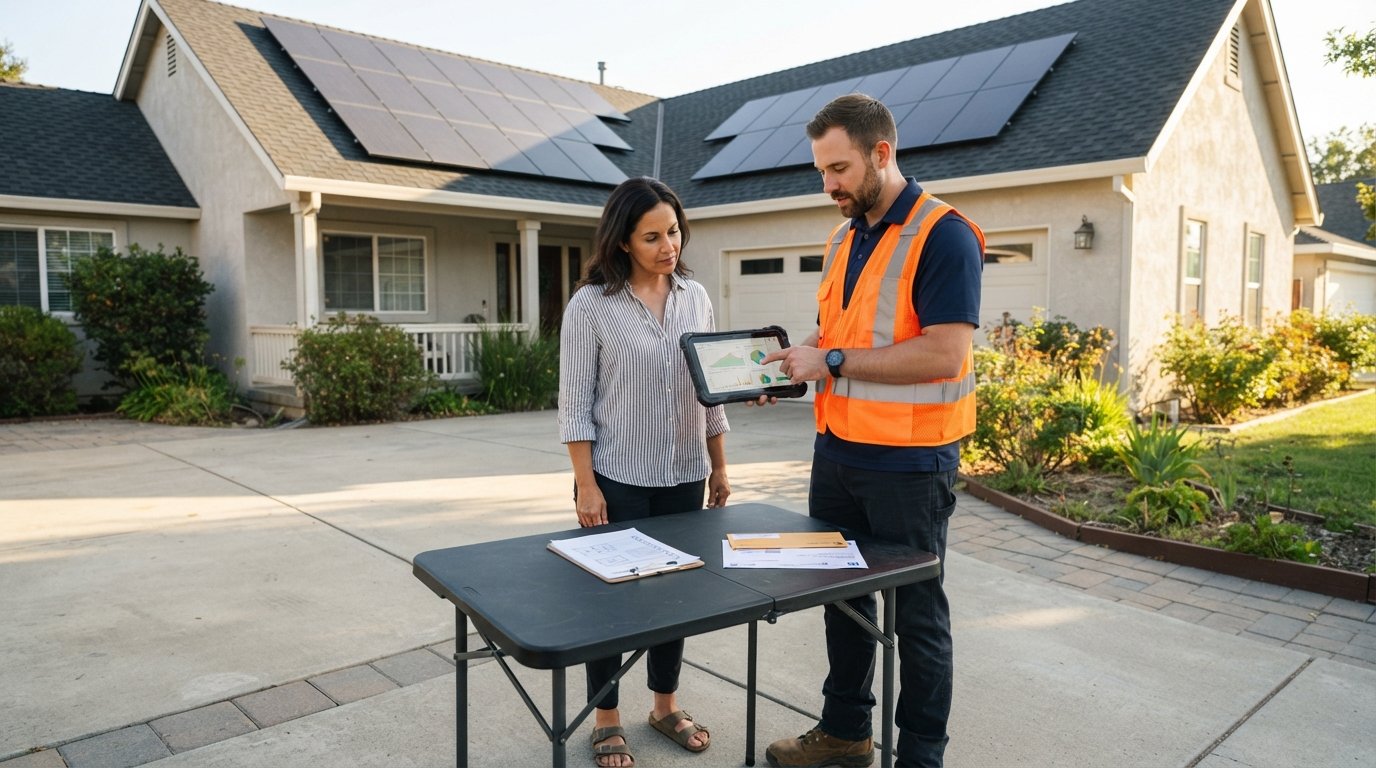
Even the richest lead data cannot tell you whether a roof is suitable for solar. Shading, roof age, structural condition, orientation, and available space all require a human review, either through satellite imagery, a remote assessment, or an on-site survey. This is where many installers lose efficiency: they send a full proposal before confirming the site can support the system. A better approach is to build a lightweight site review into your qualification workflow before you invest in design and proposal work.
Start with a satellite or aerial review of the property. Most installers use tools that can estimate roof area, orientation, and shading from imagery. If the roof is heavily shaded, too small, or in poor condition, flag the lead for a conversation before scheduling a survey. If the roof is older than 15 to 20 years, the homeowner may need a replacement before or alongside the solar installation, which changes the project scope and cost. That is not necessarily a disqualifier, but it is a factor that needs to be addressed early. A short phone call can confirm roof age, known leaks, and whether the homeowner has plans to replace the roof in the near future.
Site suitability also includes the electrical panel. Older homes may have panels that cannot handle the additional load from a solar system, which means an upgrade is required. A quick question about the panel's age and amperage can save a wasted site visit. Finally, confirm that the homeowner has the authority to install solar, which is usually straightforward for owner-occupied single-family homes but can be more complex for properties in HOA communities or historic districts. A brief conversation about HOA rules and any known restrictions will prevent surprises later.
Prioritizing Leads by Bill Size and Likely System Offset
Once you have the three core data points and a preliminary site review, you can rank leads by expected value. The simplest and most effective ranking method is to combine bill size with credit tier and homeowner status. Here is a practical framework you can implement in a spreadsheet or CRM today:
- Tier 1 (priority): Homeowner, bill over $200 per month, top or upper-middle credit tier, roof with good solar access. These leads should be contacted within minutes of arrival, because high-intent homeowners often inquire with multiple installers.
- Tier 2 (nurture): Homeowner, bill $100 to $200 per month, mid-tier credit, roof suitable or with minor shading. These leads are worth a call, but they may need more education and a smaller system design.
- Tier 3 (qualify further): Homeowner, bill under $100 per month, or credit tier below your lender minimum, or roof condition uncertain. These leads need a discovery call before any proposal work.
- Tier 4 (disqualify or refer): Renter, bill data missing, credit tier clearly below financing minimum with no cash option, or roof unsuitable with no remediation plan. Politely close the loop and move on.
This tiering system is not static. A Tier 3 lead can move up if the discovery call reveals a cash buyer or a roof replacement already scheduled. The point is to allocate your team's time proportionally to expected value, so your best closers spend their hours on the leads most likely to convert. Many installers find that Tier 1 leads convert at three to five times the rate of Tier 3 leads, which means the ranking pays for itself almost immediately.
Setting Realistic Conversion Expectations at Each Tier
Conversion rates in residential solar vary widely by market, season, and sales process, but having realistic benchmarks helps you evaluate lead quality and team performance. The following ranges are typical for installers using pre-qualified leads and a structured follow-up process. Treat them as starting points and adjust based on your own historical data.
- Tier 1: 15 to 25 percent close rate from lead to signed contract, assuming fast contact and a professional sales process.
- Tier 2: 8 to 15 percent close rate, often with a longer sales cycle and more design iterations.
- Tier 3: 3 to 8 percent close rate, heavily dependent on the discovery call and financing alternatives.
- Tier 4: Below 2 percent, which is why most installers do not invest sales time here.
These numbers are not destiny. If your Tier 1 close rate is below 10 percent, the problem is likely speed to contact or sales process, not lead quality. If your Tier 3 close rate is unexpectedly high, you may be under-filtering and leaving money on the table. Track conversion by tier, by lead source, and by setter or closer, and use that data to refine your qualification criteria over time. For a deeper dive into turning qualified leads into signed contracts, see our guide on solar lead conversion strategy for residential installers.
Using a Discovery Call to Confirm Motivation
Data tells you whether a homeowner can buy; the discovery call tells you whether they will. Before you invest in a full proposal, design, and site survey, a short, structured phone call can confirm motivation and surface objections early. The call does not need to be long, but it should cover a few key areas: why the homeowner is interested in solar now, what their timeline looks like, whether they have received other quotes, and how they plan to pay for the system.
Start by asking what prompted the inquiry. A homeowner who says "my electric bill just hit $400 and I need to do something" is a different prospect from one who says "I am curious about solar for the future." Both are legitimate, but they require different follow-up. Next, ask about timeline: are they looking to install this season, or are they researching for next year? A homeowner with a near-term timeline is more likely to move forward quickly, while a long-term researcher may need nurturing. Ask whether they have spoken with other installers, and if so, what their experience was. This gives you insight into their decision process and any concerns you need to address.
Finally, confirm financing. If the homeowner plans to pay cash, great; if they plan to finance, confirm that they are comfortable with a credit check and that they understand the general terms. If they are unsure, offer to walk them through options. A discovery call that uncovers a financing objection early is far more valuable than a proposal that dies on the vine two weeks later. When you buy solar leads from a platform like HomeRemodelingLeads, you can use the lead data to tailor the discovery call, focusing on the specific bill range and credit tier rather than starting from scratch. If you are also buying leads for other categories, a real-time lead exchange such as PingPost.Exchange can help you understand how dynamic lead routing works and why speed to contact matters so much.
Building a Repeatable Qualification Workflow
The installers who win consistently are the ones who turn qualification into a repeatable workflow rather than a one-off effort. That workflow should include automated data checks, a human review step, a tiering system, a discovery call script, and a feedback loop that updates your criteria based on real outcomes. Start by defining your minimum criteria for each tier and documenting them in your CRM. Then train your setters to apply the criteria consistently and to escalate edge cases to a sales manager.
Review your qualification criteria quarterly. Markets change, financing products change, and your own installation capacity changes. A criteria set that worked when you had a full pipeline may be too loose when you are capacity-constrained, and vice versa. Use your closed-won and closed-lost data to identify which data points actually predicted success. You may find that bill size matters more than you thought, or that a particular credit tier converts better than expected. Adjust accordingly.
Finally, remember that qualification is a partnership between your team and your lead provider. Provide feedback on lead quality, flag patterns of bad data, and take advantage of any credit or replacement policies. Platforms like HomeRemodelingLeads offer pre-qualified solar leads with homeowner status, electricity bill range, and credit rating data already captured, which gives you a strong starting point. Combine that data with a disciplined human review and a structured discovery call, and you will spend less time chasing dead ends and more time installing systems.